
Here is the audio from Senator Zinke’s July 31 appearance on The Jerry Doyle Show.
SOFA - Special Operations for America
2012 The Battle to Take Back America
Here is the audio from Senator Zinke’s July 31 appearance on The Jerry Doyle Show.
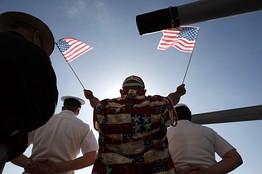 Wall Street Journal - Washington is battling these days over “sequestration,” the $500 billion additional cut to the defense budget looming in January. The White House and Democrats on Capitol Hill insist that intransigent Republicans are risking cuts that no one wants. This is a charade. By his own admission, President Obama has always wanted to cut the defense budget dramatically.
Wall Street Journal – Washington is battling these days over “sequestration,” the $500 billion additional cut to the defense budget looming in January. The White House and Democrats on Capitol Hill insist that intransigent Republicans are risking cuts that no one wants. This is a charade. By his own admission, President Obama has always wanted to cut the defense budget dramatically.
In April 2011—long before the near shutdown of the government and the last-minute debt-ceiling deal, which paved the way for sequestration—the president outlined $400 billion in defense cuts he had already approved. He also said that he wanted to “do that again” and find another $400 billion in military spending reductions. All this without any talk of threats, strategy or requirements—just arbitrary budget targets imposed on the military.
It’s clear that Mr. Obama prioritizes sundry domestic spending programs over the defense budget. That budget “is so big,” he said last July, “that you can make relatively modest changes to defense that end up giving you a lot of head room to fund things like basic research or student loans or things like that.” He added later: “A lot of the spending cuts that we’re making should be around areas like defense spending as opposed to food stamps.”
Even before sequestration and the possible loss of a half-trillion dollars, the U.S. military has seen three years of budget cuts. The consequences are already here. We have to look all the way back to 1916 to find a year when the Air Force purchased fewer aircraft than are included in Mr. Obama’s 2013 budget request.
Many of the Air Force’s aerial refueling tankers predate human space flight. Training aircraft are twice as old as the students flying them. The F-15 fighter first flew 40 years ago. A-10 ground-attack planes were developed in the Carter years. And all of our B-52 bombers predate the Cuban missile crisis.
Then there’s the Navy, which is the smallest it has been since 1916. At 286 combat and combat-support ships, the Navy today is less than half the size it reached during the Reagan administration. And what about those men and women who have been fighting America’s wars in Afghanistan and Iraq since 2001? They’re losing 100,000 in active duty personnel. Surely some will go from the front lines to unemployment lines as a result.
As the largest employer in America, the Department of Defense should not be off the hook for belt-tightening. Everyone loves to hate the Pentagon’s broken acquisition system, for good reason. The emphasis on contractors often masks the government’s contribution to spiraling costs and schedule delays. And this takes the pressure off leaders to change the way the Pentagon buys not weapons but services. Of the roughly $400 billion the military spends on goods, services, information technology and commodities each year, more than half goes to services. A reformed process would emphasize competition, reduce congressional regulations, restore the authority of service secretaries, and accelerate programs for completion in seven years or fewer.
Other key reform initiatives include a long overdue review of the Pentagon’s nearly 800,000 civilian workers. While private industry has been shrinking throughout the recession, the Pentagon’s civilian workforce has grown by 10% since 2009. This and other factors (such as the bureaucratic effect of “jointness,” or collaboration between the branches of the military) have bloated the ratio of contractors and support staff to warfighters.
Then there’s the impact on American power. Military leaders have suggested that taking on Syrian President Bashar al-Assad and his Third World army would be an operation of “many, many months.” The so-called “pivot” to Asia is being mimed with fewer ships on longer deployments and a shrinking, aging air force. We’re ignoring a wholesale Chinese power grab in the South China Sea and watching the nuclearization of Iran.
There is a generic hope in Washington that funding will eventually be restored to the national defense. But any fix or delay to sequestration—let alone a rational debate about Defense Department reform—will be complicated by the difficulty of negotiating new debt-ceiling arrangements under the cloud of another possible sovereign debt downgrade.
In testimony before Congress recently, White House budget director Jeffrey Zients suggested that Congress is to blame for defense cuts. But no Republican occupies the seat of commander in chief. Mr. Obama does, and having pledged repeatedly to slice defense, he has done so arbitrarily and without an overarching strategy—before Congress ever got involved. And only Mr. Obama can broker a budget compromise. The military cannot be immune from reform, but it should at least be immune from attack.
Sequestration has become a political buzzword for the last year and a half. From liberals to conservatives, the issue strikes vitriol response. Under the Budget Control Act of 2011, the President raised the national debt roughly $2.5T in exchange for equal cuts to discretionary spending. This means President Obama agreed to make all these cuts without touching any mandatory welfare programs; including Social Security, Medicare and Medicaid. These are the true drivers of the debt – responsible for 60 percent of the annual budget. Yet, they are protected.
Sequestration has become a political buzzword for the last year and a half. From liberals to conservatives, the issue strikes vitriol response. Under the Budget Control Act of 2011, the President raised the national debt roughly $2.5T in exchange for equal cuts to discretionary spending. This means President Obama agreed to make all these cuts without touching any mandatory welfare programs; including Social Security, Medicare and Medicaid. These are the true drivers of the debt – responsible for 60 percent of the annual budget. Yet, they are protected.
Since Defense makes up half of all discretionary spending it will bear over $1T of the proposed cuts. $487B has already been cut, while the remaining $500B+ stands in political limbo. This is sequestration; a $500B cloud that hangs over the economy and more importantly those who serve in the defense of the country. In today’s age of austerity, the government needs to cut spending. However, everyone would agree that any cuts must be targeted toward the unsustainable portions of the budget. Reports have shown that Medicare, Medicaid and Social Security are all on track to go bankrupt in the near future. Each program is in dire need of reform. With that in mind, the natural assumption would be that the President would propose reforms to save the budget and these programs. However, with the Budget Control Act, the President has placed the bulk of cuts square on Defense. The bill was set up so the President and Congress could come to a comprehensive deal to avert these drastic cuts. The Secretary of Defense, Chairmen of both Armed Service committees and Joint Chiefs of Staff have all said sequestration would be devastating to national defense. Secretary Panetta said it would be tantamount to “shooting ourselves in the head.” It would literally gut defense across the board with no discretion; all while social welfare programs remain untouched and headed for bankruptcy. Rather than cutting a workable deal, the President proposed a budget with massive tax increases that received zero votes. Neither House Republicans nor Senate Democrats voted in favor of the President’s plan. Meanwhile, Republicans have proposed and passed multiple bipartisan plans to deal with sequestration but they have been killed by the President and Senator Reid. The plans have not even been brought up for a vote! Today’s scenario demands leadership to develop a worthy plan. Republicans have offered to close tax loopholes, reform welfare programs and cut the federal workforce, while the President has only demanded higher taxes. He and his Democrat allies have decided to hold sequestration as leverage to push for higher taxes. Essentially, $500B in crippling national defense cuts are rapidly approaching and Democrat’s response is, “I’ll let them hit if you don’t raise taxes.” Recently, both Senators Reid and Murray said they would play hardball with sequestration if taxes were not raised. Somehow raising a poultry amount of taxes on the rich is as important as averting a $500B bullet. Even as Sequestration heads straight toward us, the Obama administration is trying to mask the effects it would produce. Along with crippling our national security, sequestration is expected to cost roughly 1-2 million defense jobs. Industry has reported that it is required under the WARN Act to send termination notices at least 60-90 days before employees are to be let go. This means warning letters would be sent to voters just a few days before the election. In order to try and escape political consequences, the Obama administration is telling defense contractors that they do not have to send the notices, which is in direct conflict with the law! Massive job losses are coming down the pike. President Obama and Democrats want to hide any of the real effects of sequestration, because it will hurt them politically. In reality, this is not a political conundrum: it is about the crushing effects to national security and the economy.
“As one of the most senior military officers recently said; this is the most dangerous time he has seen in his four decades of service. Despite that warning, sequestration would do what no other external enemy could — cripple our economy and defenses in a single blow,” Buck McKeon, Chairman House Armed Services Committee. As this is being written, sequestration is still headed straight towards our national defense. The Obama administration recently announced that military personnel would be exempt from sequestration, which means all $500B will be cut out of procurement, research and development and military construction. The cuts would wipe out funding for the equipment needed to serve effectively. Meanwhile, the President and his Democrat allies have decided to play a game of political chicken – leveraging the defense of the nation against politically motivated tax hikes. The two are not comparable. The men and women who have taken an oath to serve this country deserve better than a game of political roulette.
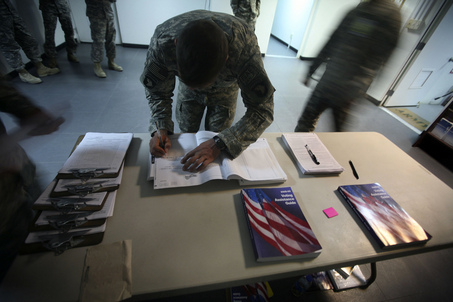 Breitbart.com - President Barack Obama, along with many Democrats, likes to say that, while they may disagree with the GOP on many issues related to national security, they absolutely share their admiration and dedication to members of our armed forces. Obama, in particular, enjoys being seen visiting troops and having photos taken with members of our military. So, why is his campaign and the Democrat party suing to restrict their ability to vote in the upcoming election?
On July 17th, the Obama for America Campaign, the Democratic National Committee and the Ohio Democratic Party filed suit in OH to strike down part of that state’s law governing voting by members of the military. Their suit said that part of the law is “arbitrary” with “no discernible rational basis.”
Currently, Ohio allows the public to vote early in-person up until the Friday before the election. Members of the military are given three extra days to do so. While the Democrats may see this as “arbitrary” and having “no discernible rational basis,” I think it is entirely reasonable given the demands on servicemen and women’s time and their obligations to their sworn duty.
The National Defense Committee reports:
[f]or each of the last three years, the Department of Defense’s Federal Voting Assistance Program has reported to the President and the Congress that the number one reason for military voter disenfranchisement is inadequate time to successfully vote.
I think its unconscionable that we as a nation wouldn’t make it as easy as possible for members of the military to vote. They arguably have more right to vote than the rest of us, since it is their service and sacrifice that ensures we have the right to vote in the first place.
If anyone proposes legislation to combat voter fraud, Democrats will loudly scream that the proposal could “disenfranchise” some voter, somewhere. We must ensure, they argue, that voting is easy and accessible to every single voter. Every voter, that is, except the men and women of our military.
Make no mistake, the Democrat lawsuit is intended to disenfranchise some unknown number of military voters. The judge should reject it with prejudice.
 World Net Weekly - A former SEAL Team 6 member is speaking out about the national security consequences of having Barack Obama as a commander-in-chief.
Montana State Sen. Ryan Zinke has launched Special Operations for America, a Super PAC that lists its mission as being committed to a strong and independent military, American exceptionalism and identifying and providing accurate information on policies that harm or discredit national security and members of the military.
Zinke spent 23 years in the Navy as a SEAL, going back to the Reagan administration. During his career he led counter-insurgency and contingency operations in the Persian Gulf and the Pacific theater of operations. He also was a SEAL commander is support of Bosnia, Croatia and Kosovo. During Operation Iraqi Freedom, he was responsible for killing or capturing 72 known enemy insurgents. In 2006, he was awarded two bronze stars for combat.
Appearing on Sean Hannity’s show on Fox News, Zinke said he was not forming SOFA for personal gain, noting that he would not be taking any type of salary from the organization. “I’m not taking a paycheck, I’m doing this for God and country.”
World Net Weekly - A former SEAL Team 6 member is speaking out about the national security consequences of having Barack Obama as a commander-in-chief.
Montana State Sen. Ryan Zinke has launched Special Operations for America, a Super PAC that lists its mission as being committed to a strong and independent military, American exceptionalism and identifying and providing accurate information on policies that harm or discredit national security and members of the military.
Zinke spent 23 years in the Navy as a SEAL, going back to the Reagan administration. During his career he led counter-insurgency and contingency operations in the Persian Gulf and the Pacific theater of operations. He also was a SEAL commander is support of Bosnia, Croatia and Kosovo. During Operation Iraqi Freedom, he was responsible for killing or capturing 72 known enemy insurgents. In 2006, he was awarded two bronze stars for combat.
Appearing on Sean Hannity’s show on Fox News, Zinke said he was not forming SOFA for personal gain, noting that he would not be taking any type of salary from the organization. “I’m not taking a paycheck, I’m doing this for God and country.”
Zinke also has made it a point to emphasize that his issues with the president are not personal, but rather over national security concerns.
“We’re going to be very careful in our delivery of message, we want to make sure that everything we say is well-documented … I don’t dislike the president personally, I dislike his policies as commander in chief.”
He said that among his concerns are national security leaks that some have said have come from the White House. He also takes issue with the president making the death of Osama bin Laden into a campaign issue.
Appearing on Bryan Williams’ show after the raid, Obama said, “we thought about the fact that if there was a failure here, it would have disastrous consequences for me politically.”
Visit the website for Special Operations for America.
“Enough is enough. It started with bin Laden and a commercial with former President Clinton and not just taking credit for it but taking the consequences for the decision,” Zinke lamented. “The consequence of failure was really about the guys on the ground and the reason why the operation was successful was because of the enormous capability and dedication” of all service members involved in the operation.
In the commercial, Clinton referring to Obama’s decision said, “Suppose they had been captured or killed. The downside would have been horrible for him.” Critics noted that the ad made no mention of the consequences for the American soldiers and their families if they would have been killed during the mission.
Zinke says on SOFA’s site that he sees strong national security parallels between 1980 and today.
“As commander-in-chief, President Reagan inherited a nation that was at a cross roads in terms of heightened tensions between the Soviet Union and a military that had been downsized and weakened,” he said. “Through his leadership and vision, America’s military was strengthened and emerged as the world’s sole superpower with a force ready and capable of protecting our national interests. We must remain strong, vigilant and committed to protecting our freedom and values.”
“Today, our nation stands once again at a cross roads. We have a commander-in-chief who freely takes credit for the heroic actions of others for political gain, a president who apologizes to other nations for America defending itself, and an administration that is willing to put our troops at greater risk by negotiating away our ability to fight and win,” he said.
The organization, which is still in the process of raising funds, is sponsoring a car in this weekend’s NASCAR Sprint Cup Series at the Indianapolis International Raceway. The organization’s name and logo will be featured on the hood and rear quarter panels of car No. 32.
Zinke also notes that under the current administration, the military has been muzzled to the point where members are afraid to speak their mind about national security concerns.
“It is time for action. Our active duty forces have been silenced and it is the duty of those who have served to speak out on their behalf,” he said.
WND reported that the Marine Corps used an order directed at officers to discharge a Marine sergeant who expressed concerns about the president’s leadership on his personal Facebook page.
Sgt. Gary Stein issued posting on his personal Facebook page that were critical of Obama and his policies. The military has regulations regarding what service members can and cannot say while in an official capacity. However, Stein’s page made no reference to his being a Marine and did not feature any photos of him in uniform.
Despite this, the Marines fast-tracked Stein for a discharge just a few months before his enlistment was up. Stein had several supporters including Brig. Gen. David Brahams, a former staff judge advocate for the Commandant of Marines.
Brahams, who has been a Marine for over 50 years, with 49 of them as a lawyer, issued a statement saying the directive against Stein was confusing and hard for even him to understand.
“My reading of it indicates it is confusing and quite unhelpful. It is also inherently contradictory,” Brahms said. “If I cannot understand 1344.10 as a 74-year-old retired brigadier general and staff judge advocate to the Commandant of the Marines, there is little hope that a sergeant would understand.”
According to the Marine Corps Times, there is a definite need for Zinke’s organization. A March 26 article titled, “Anti-Obama Marines” reported that a Military Times poll revealed that there was an identifiable segment of respondents who disapproved of the way the president is handling his job as commander-in-chief.
Zinke told Hannity the reason he formed SOFA was to ensure that people such as Stein and other service members have a voice in the presidential election.
“Special Operations for America is a grass roots PAC aimed at giving the military a voice,” he said.
I remember the day I found out I got into West Point. My mom actually showed up in the hallway of my high school and waited for me to get out of class. She was bawling her eyes out and apologizing that she had opened up my admission letter. She wasn’t crying because it had been her dream for me to go there. She was crying because she knew how hard I’d worked to get in, how much I wanted to attend, and how much I wanted to be an infantry officer. I was going to get that opportunity. That same day two of my teachers took me aside and essentially told me The following: “David, you’re a smart guy. You don’t have to join the military. You should go to college, instead.”